Thursday, 28 May 2009

Mad Dogs and Englishmen

I have more than a passing interest in natural power - power provided by the wind, sea or sun.

We have a wind generator on Willawaw - a monster of a thing. The problem we have found is that the wind strength on the cut is rarely strong enough to generate a lot of electricity.

While the tops of the trees can bend over double in a gale, the water surface will only have ripples. The blades of the windgen tend to be too low down to pick up the gusts.

Although there are exceptions to all rules, most canals are pretty sheltered !! 

Solar power seems more practical on the inland waterways - power is produced even in quite mediocre light conditions.

I believe there is still some way to go with solar panel technology, but things are improving in leaps and bounds.

The owner of Harvest was quite adamant that he wanted solar panels on his boat.

They would never provide enough power to replenish the power taken by the drive motor, but as Paul intended to spend a lot of time moored to the bank in remote spots, it did seem practical for panels to provide enough power for lighting, TV and laptop use and so on.

Solar panels generate a lot more power when their flat panel surface is at right angles to the rays of the sun. As the sun moves across the sky, this means that fixed, horizontal panels bolted on the roof of a narrowboat, are not in an optimum position for very long.

The original plan was to fit a little device that I designed with a friend, called the Gizmo.

Basically, it senses the strength of the sunlight and rotates the panel by use of a motor drive, to track the sun. Although the design was proven technically, the cost of production was prohibitive and we decided not to pursue it further than the prototype stage.

The movie below, shows it strutting its stuff, whilst fitted with a small test panel and tracking the light from a moving electric light.

In the end, Paul decided that he would mount the panels mechanically, so they could be rotated manually and their elevation altered by means of extendable, telescopic arms.

To assist with the setting up of the two independent panels, I produced this solar meter.

It simply clips on to the output of each panel and the panel is then manually moved around until the needle on the meter shows maximum. It cost only a few pounds to make and is simplicity itself. 

We couldn't understand why Paul was reporting that even in quite dull conditions, the needle was over at the stops. At first I thought there was a fault in the design or components.

Then, Paul mentioned in an e-mail that he was measuring about 50 Volts.

50 Volts from a 12V solar panel ?? impossible...

It didn't take long for the penny to drop.

Despite a circuit diagram that says 2 x 12V Kyocera panels, Paul purchased two 24V models and the bombshell had lain undetected for two years in a barn, until the panels were connected up last week to give 50V !!!

Anyhow, now we know why, the problem has been resolved.

Back to the drawing board with the solar meter, though - it will need a bit of a component tweak to work with a 24V panel instead of the anticipated 12V panel !!! C'est La Vie.

3 Years in the Making


About three years ago, I met a man on the Internet called Paul.

Paul lived in Germany and had a dream.

He wanted to build an eco-boat.

We corresponded by e-mail and he was quite clearly insane.

He didn't know anything about inland waterways craft, he wanted a boat that didn't use diesel at all and he planned to live off solar power and rain water.

The man was obviously barking mad.

However, there was a single minded, dogged clarity about his vision.

The details slowly unfolded.

Paul was retired, he wanted to come back to the UK to live and had drawn up a blueprint of his dream boat.

He wanted the boat to be propelled by an electric motor, have its batteries charged by the sun and an LPG generator and be steered by a flap rudder that worked like the ailerons of an aeroplane.

My area of speciality happens to be marine electrics and electronics.

For fun, I designed the 230VAC mains, 48VDC and 24VDC electrical systems for him.

It was all done at distance - he in Germany and myself on Willawaw in the UK.

In about 2006, he went to Crick and placed the order for a 58 foot hull with Mel Davis Boatbuilders.

Paul placed orders for all the vessels' equipment including the drive motor, motor controller, battery chargers, an inverter, some very expensive traction batteries, a bow thruster and so on, in accordance with my designs.

Slowly, the boat began to take shape.

Paul kept me up to speed with the build by sending me regular e-mails and photographs.

He moved across to the UK to oversee the construction of his beloved boat, which became known as "Harvest".

The "go faster" stick shown left was a complete indulgence - taken from a big ship supplier, it cost more than the Lynch motor.
As the project began to progress, I met Paul for the first time.

Harvest became reality - not a beautiful baby - in fact, quite an ugly duckling to any boat lover, used to curved lines and form.

However, Harvest is functional.

Inside, she is a veritable tardis.

She has underfloor heating, beautiful woodwork and has been virtually handbuilt by Paul, within the Mel Davis expertly-constructed shell.

A month or two ago, Harvest was lifted on to a truck and taken to Mercia Marina, where she kissed the murky, brown water for the first time.

The running up of propulsion, steering and other systems revealed various small teething problems that had to be resolved.

The motor was overheating due to incorrect gearing, the Honda genset was overheating as its water cooling had been modified to work on a keel cooler and some boaty things still needed to be installed, but Harvest finally got there.

A lot is being written about hybrid drives at the moment. Several hybrid boats have just been shown at the Crick Show.

Harvest is an all-electric boat. In line with Paul's original brief, she is diesel free.

Today, Paul set off from Mercia Marina to start his electric voyage of the U.K.

She has taken over 3 years to build.

Bon Voyage Paul.   

Wednesday, 27 May 2009

Bite Me

I'm nursing some beautiful bites on my legs.

Its a consequence of wearing shorts on the river. Once we are past Easter and the weather starts to warm-up, I tend to wear shorts until September (not the same pair, you understand !!).

Blackfly (Diptera Simuliidae)  are those very black, moth-like flies that hover close to the water surface. There are apparently 40 or so different types in the UK alone, with some 1500 species worldwide.

In Africa, they can cause river blindness, but here in Blighty, they're just a bloody nuisance.

Their bites are very, very itchy and they often end up bringing your skin up in lumps.

The male flies collect in huge swarms which, on calm sunny days, dance in the air near trees, awaiting the arrival of the females.

The female flies enter these swarms and are seized by a male before the mating pair falls to the ground.

Before or after mating the female flies frequently seek a meal of blood to supplement their diet and assist in the production of eggs. They like human blood especially. 

In terms of treatment, victims are advised to clean the bite wound with soap and water and dry gently. 

Creams that contain camomile lotion, steroid cream, or anaesthetic can soothe the pain of the bite, as can an antihistamine tablet.

Do not apply cream or ointment to broken skin and always follow the instructions on the packet.

Try to avoid scratching the bite- although it may be very itchy - because you may damage the skin and allow bacteria to get in.

Alternatively, don't wear shorts.

Tuesday, 26 May 2009

Taking the Wii

Its been a bit of a slack day today.

Torrential rain in the morning and high winds all day, we decided to stay put and get some work done. My satellite link enabled me to get lots done, even though the Vodafone 3G was non-existent. 

Yesterday was a different kettle of fish though.

The greyness in the sky cleared at about 3pm, so on the spur of the moment, we decided to go for a paddle. 

We unpacked the Grabner inflatable canoe we call "Shamu" (after the killer whale 'cos its large and black) from its valise, laid it out on the coachroof and began pumping with the stirrup pump supplied.

Ten minutes later, all was ready and we set off.

The late afternoon sun was warm, the wind was non-existent and all we needed to wear was T-shirt, shorts and flip-flops. It's what boating is all about, really.

We couldn't find the first mates buoyancy aid (must have got shuttled home in one of our occasional tidiness binges). So, she wore one of the self-inflating lifejackets that we keep onboard for bad weather and tidal use.

We had a nice paddle (about 3 miles), got bitten by gnats and were ravenously hungry on our return.   

It got me thinking about inflatable canoes again and electric motors.

My recent discussion with another Mark on the Just Canals forum on the subject, got my cranial juices flowing again.

I keep telling myself that the act of paddling is keeping me fit and my waistline in trim.

However, my laziness and love of gadgets keeps telling me that it would be nice to have an electric motor on the canoe for such excursions.

You know how it is. The voice from the creature sitting on one shoulder says "it would help you get home if you get tired of paddling", "it would give you a chance to look at the scenery more", "it would be better for the first mates dodgy back".

The voice from the creature sitting on the other shoulder says "more crap to find a home for", "it's going to take longer to set up", "where is the battery going to go in a blow-up boat ?"

The logical part of my brain is saying that I don't really need an electric motor on the tender for Willawaw, but I was surprised at how cheap they are, when compared to petrol outboard motors.

The adaption kit for the canoe, which consists of two outrigger floats and a cross member (allowing the motor to clamp on, out-board of the gunwhale) is 75 Euro (about £75 these days) and the Minn Kota Endura 30 electric outboard is £189 at Ely Chandlers. 

By comparison, the Honda 2.3HP petrol outboard is about £500.

I know I have to fit a 100AH battery in a battery box, etc, but even so !!!!

Petrol is not an option - don't want to have to store it onboard, its not a green solution and the electric licensing option is cheaper.

On the licensing front, I might be able to get away with no additional cost on the grounds that it's a tender for Willawaw and she already has a gold licence ??? I seem to recall that there is something in the licencing small print about tenders being allowed ? 

Looking around the world wide webby, there are various movies of electric canoes and kayaks, but this one takes the biscuit or is it the Wii ?

Monday, 25 May 2009

Davy's On The Road Again

Remember this old Manfred Mann song ??

Manfred Mann and his Earth Band - quite appropriate really as we set off again, complete with tunes in our Sony boombox.

Pulled the pins and started cruising the Nene after a respite of several weeks due to work commitments.

We had forgotten quite how beautiful the river is.

We stopped at the Kings Head at Wadenhoe - one of my favourite places. The pub is fine, but the view is - wow.

The last time we stopped here on the way in to the Fens, we were overjoyed to see Jim Stead and his boat Lorna Ann.

Jim is a megastar in the canal and boating world and his website is the wikipedia of the waterways.

My own rules precludes me from linking to him, as he has the dratted Google ads, but I'm sure you'll find him if you're that interested...

Incidentally, a bit of canal tittle tattle or what was called Scuttlebutt in the navy.

I hear that Jim is selling (or has probably sold) Lorna Ann. Apparently, ill health (his wife rather than Jim, I recall) was forcing him to abandon the watery roving life.

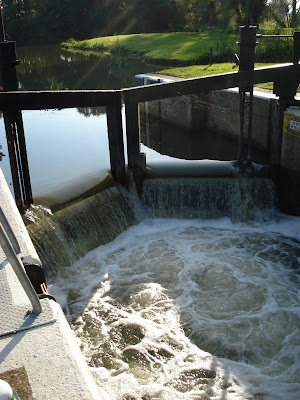
The picture on the right shows two boats coming through Wadenhoe Lock.   

There is a lovely walk from the pub mooring, past the village school and up the hill to the old church.

Unfortunately, for such a beautiful place, it, like so many other beautiful places, suffers from vandalism and the church doors have to be locked.

We so much prefer the rivers to the canals.

The rivers have so much more life and are quite timeless.

As benign as they look in May, when the sun is shining, they can be beasts in times of heavy rainfall.

The levels and the rates of flow can pin you down for weeks, sheltering in marinas and off-line moorings while swollen, angry, brown waters rage past to find the sea.


So, as the sun goes down on Wadenhoe, we head westwards, to glory, greatness and the Carlsberg Brewery at Northampton. 

Sunday, 24 May 2009

Crick ? - No Thanks


We pondered whether it was worth us going to Crick yesterday.

Having experienced the bank holiday build-up traffic on Friday night, I was reluctant to venture out in the car again over the weekend. The queues and masses at the Crick Boat Show just didn't appeal somehow.

Crick is a fine show, if you want to look around with a view to buying a boat or hunt for a bargain.

However, we don't need anything. We are fully stocked with ropes, fenders, piling hooks and so on. We will just end up munching overpriced hog roasts and buying tat.

So, we took a mature and informed decision and decided to stay put.

Well, that's not quite true. We ventured out to the nearest retail park (and I mean nearest). The point of the exercise was to minmise car time, after all !!

If you know anything about me, you will know that I like gadgets. 

In saying that, I don't just buy any old gadget - it has to earn its keep and pull it's weight, in order to have it's own little corner of Willawaw.

Space is always at a premium on a narrowboat.

We have very few books on the boat (they are all at home - several thousand of them), all our manuals and photographs are stored electronically on a removable hard disc and backed up by several memory sticks and our music is stored digitally. We don't even possess a board game onboard.

Both myself and the first mate are committed iPod freaks and have quite a collection of iTunes music between us. We also tend to have an unlimited amount of brand loyalty to Mr.Sony.

Most of the entertainment equipment on board is Sony; laptop, PC, camera, TV, etc.

So instead of spending cash on Crick in the form of diesel, entrance tickets, food and tat from the stalls, we bought a Sony SRS-BT100 Bluetooth Speaker unit, which was probably a similar sum.

This enables us to play music from our Apple iPods and beam the music wirelessly by Bluetooth to the 30W stereo speakers in the BT100.  Either of our iPods can play music through it, by means of a Bluetooth dongle.

The basic speaker unit runs from 12VDC (even though we are using it off our inverter at 230VAC) and it also takes a wired input from the laptop as well. 

So, in true laziness, we can lay on the couch, lay in bed or sit at the dinette and control the sounds flowing through the boat, from the palm of our hand.

The unit only measures 400x160x175mm, so takes up a lot less space than a conventional hi-fi.


Saturday, 23 May 2009

Cover Up

We've been thinking for some time that it would be nice to have some form of shelter when steering our trad.

We are not traditionalists and the working boatmen and women may have got soaking wet when steering their traditional working narrowboats, but we don't really see the point if we don't have to.

For that reason, we have been considering for some time, how we could protect the stern from the wind, rain and even occasionally, sun.

We have seen this very simple idea, which would allow a large (golfing or patio) umbrella to be erected to keep us protected from the elements.


Simplicity itself, there is a hole in each seat, to allow the umbrella pole to go through the hole and a welded clamp arrangement below, to hold it rigid.

The alternative, is to have a cockpit bimini fabricated when we drydock.

I've looked around for inspiration, but not really seen anything that I like on other boats.

So, with a few ideas buzzing around my head, I got busy with Google Sketchup and designed my own.

It comprises of a wooden roof and windscreen, with a hinge between them.

When not in use, they hinge forwards and fold flat on to the hatch, out of the way.

When erected, fabric side screens and a zippable back screen can be added using press studs, to make a snug and watertight cockpit around the steerer.

There is even a windscreen wiper fitted above the front screen.

The wiper is a 12V straight line unit, with a quick release power connector and the motor hidden in the pelmet on the top of the front screen.